
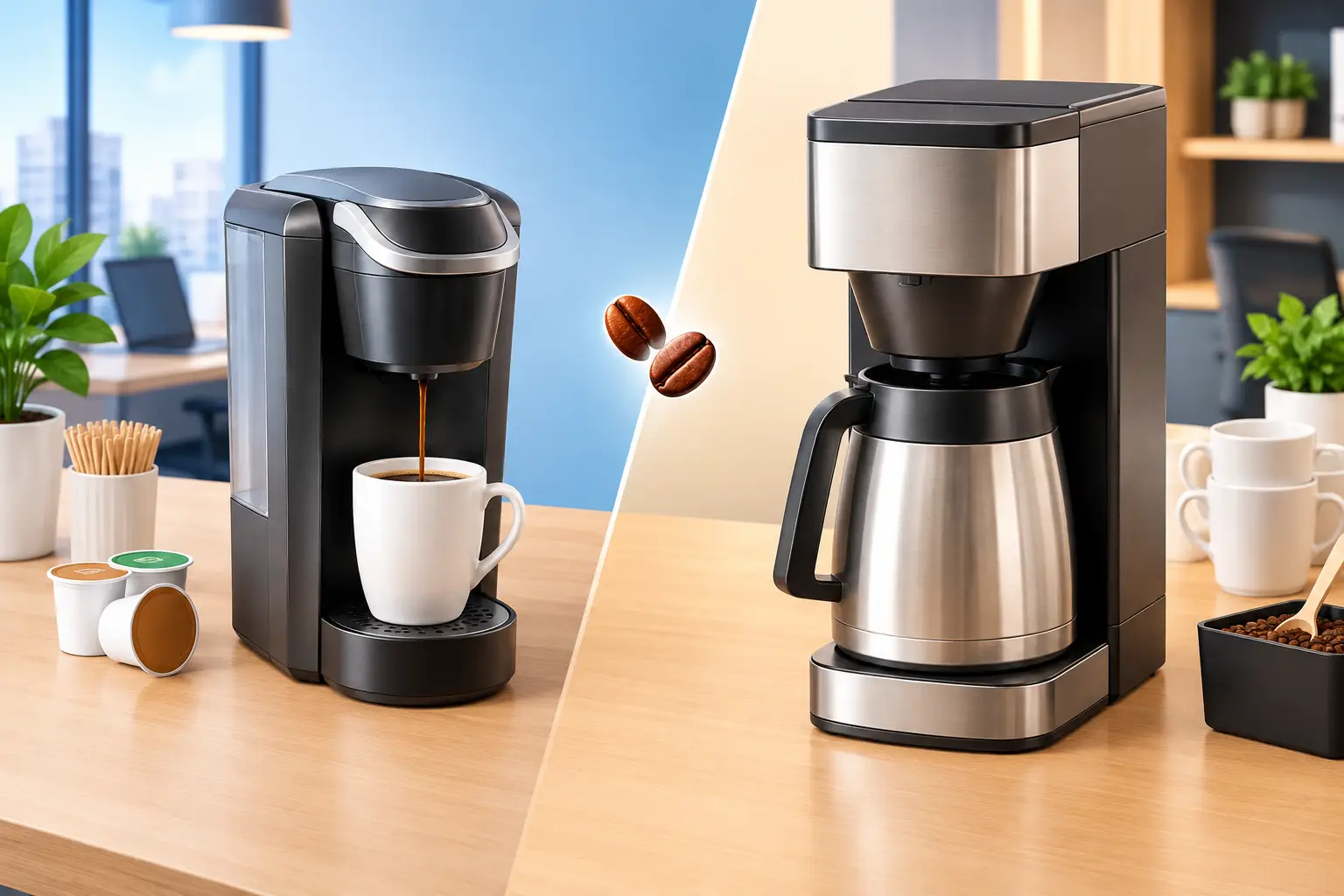
The single cup vs thermal brewer decision usually comes down to one question: does your office need coffee made for the individual, or coffee ready for the group? Both options can improve the break room, but they support very different traffic patterns, employee preferences, and service needs. The right choice keeps coffee available when people want it, reduces waste, and gives your team a better daily experience.
For office managers and facilities teams, the machine itself is only part of the decision. Coffee demand changes throughout the day, guests may need a simple option, and the break room still needs to operate reliably when schedules get busy. A good coffee program accounts for all of it.
Single Cup vs Thermal Brewer: The Core Difference
A single-cup brewer prepares one fresh beverage at a time, typically using a pod, capsule, or portion pack. Employees select their preferred coffee, tea, hot cocoa, or specialty beverage and brew it on demand. The result is choice and convenience, with no shared pot sitting after the morning rush.
A thermal brewer prepares a larger batch of coffee and holds it in an insulated thermal server. Rather than relying on a glass pot and warming plate, the thermal server maintains serving temperature without continually heating the coffee. It is designed for offices where several people may want coffee within the same window of time.
Neither format is automatically better. A small professional office with varied tastes may get more value from a single-cup system. A busy reception area, call center, training room, or larger office may benefit from thermal brewing because multiple servings are ready immediately.
When a Single-Cup Brewer Makes Sense
Single-cup systems are a strong fit when beverage variety matters as much as coffee volume. A team may include dark-roast drinkers, decaf drinkers, tea drinkers, and employees who only want an occasional cup. With individually portioned options, each person can make a selection without opening a new bag of coffee or brewing an entire pot.
This format also helps offices control coffee waste. If only a few people are in the office on certain days, brewing by the cup prevents the common problem of pouring out a half-full pot at noon. Hybrid schedules have made this a meaningful consideration for many workplaces, especially where headcount varies day to day.
Single-cup brewers are often easy for visitors and new employees to use. The process is familiar: select a beverage, place it in the brewer, and start the cycle. That can be useful in client-facing offices where a quick, consistent cup is part of the hospitality experience.
There are trade-offs. Brewing one cup at a time can create a line during a busy morning period. The per-serving supply cost may also be higher than brewing coffee in bulk, depending on the products selected. An office with heavy coffee consumption should consider whether a single-cup unit will keep pace or whether it should complement a larger brewing system.
Best Office Profiles for Single-Cup Coffee
A single-cup brewer tends to work well for small to midsize offices, executive suites, conference rooms, flexible workplaces, and locations with a broad mix of beverage preferences. It is also a practical choice for an office that wants recognized coffee and tea brands available in a compact footprint.
The key is to look beyond total employee count. An office of 40 employees with staggered schedules may be an excellent fit for single-cup brewing. An office of 20 employees who all arrive at 8:30 a.m. may experience a very different demand pattern.
When a Thermal Brewer Is the Better Choice
A thermal brewer is built for speed at scale. When several employees want coffee at once, a fresh batch in a thermal server allows people to pour and go. There is no wait for an individual brew cycle, which can make a noticeable difference in offices with concentrated break times.
Thermal brewing is generally a practical choice for workplaces with steady daily consumption. It can provide a lower cost per cup than individually portioned beverages and gives coffee drinkers the familiar experience of a fresh, readily available pot. For many traditional office coffee programs, that combination remains hard to beat.
The thermal server is an important advantage. Since it holds heat without a burner, coffee is less likely to develop the scorched taste associated with coffee left on a warming plate. Quality still depends on using the right amount of coffee, brewing at the appropriate intervals, and keeping the equipment clean, but a thermal setup gives the office a better opportunity to serve coffee at its best.
A thermal brewer does require more attention to demand planning. If staff brew too much during a slow period, coffee can be wasted. If nobody takes ownership of starting a new batch before a meeting or morning rush, the server may be empty at the wrong time. These are manageable issues, especially with a dependable replenishment and service plan, but they should be considered before selecting equipment.
Best Office Profiles for Thermal Brewing
Thermal brewers are well suited to larger offices, warehouses, customer service teams, medical offices, manufacturing environments, employee cafeterias, and high-traffic common areas. They also work well for catered meetings, training sessions, and events where many guests need coffee in a short period.
For these environments, convenience means immediate availability. A coffee station that serves eight people quickly may be more valuable than one that delivers a highly customized cup to each person.
Compare Cost, Waste, and Daily Operations
Equipment selection should be based on total operating value, not just the price of the brewer. Single-cup brewing can reduce wasted coffee and provide broad menu variety, but portioned beverages can cost more per serving. Thermal brewing often provides a more economical cup for frequent coffee drinkers, but brewing too much can erase that savings.
Supply management matters as well. Single-cup programs need enough variety to satisfy employees without overstocking slow-moving flavors. Thermal programs require a reliable rotation of coffee, filters, cups, stirrers, creamers, sweeteners, and often decaf options. In either case, a well-managed break room prevents small shortages from becoming employee frustrations.
Cleaning routines are different, too. A single-cup brewer needs regular cleaning, descaling, and attention to the pod area and drip tray. A thermal brewer needs clean brew baskets, servers, spray heads, and surrounding counters. Neither approach is maintenance-free. The advantage comes from having equipment suited to the environment and a service partner ready to keep it performing properly.
Consider Employee Experience, Not Just Equipment
Coffee is a daily touchpoint with workplace culture. A single-cup system says every employee can choose a beverage that suits them. A thermal station creates a shared gathering point and keeps a familiar cup of coffee within easy reach. Both can contribute to a more welcoming, productive break room when the products are fresh and the station is consistently supplied.
Some offices benefit from using both. A thermal brewer can handle the morning rush and regular coffee drinkers, while a single-cup machine offers decaf, tea, flavored coffee, and specialty options throughout the day. This setup can be especially effective in larger workplaces with diverse preferences, though it requires enough counter space and demand to justify two systems.
Before making a decision, observe the break room for a week. Note when coffee demand peaks, how much coffee is discarded, whether people ask for tea or decaf, and how often meetings require service. Those details are more useful than choosing based on office size alone.
Choose the Service Plan Along With the Brewer
The best brewer is one your team can count on. Product availability, preventive maintenance, responsive repairs, and knowledgeable recommendations all affect whether an office coffee program feels easy or becomes another task for an administrator to manage.
Certified Coffee Service helps South Florida workplaces match equipment, coffee, tea, water, and break room supplies to their actual needs, with Service Above All guiding every recommendation. A well-supported program can adjust as your office grows, schedules change, or employee preferences shift.
Choose the brewer that fits the way your people actually take breaks, then make sure the service behind it is ready for every cup.