
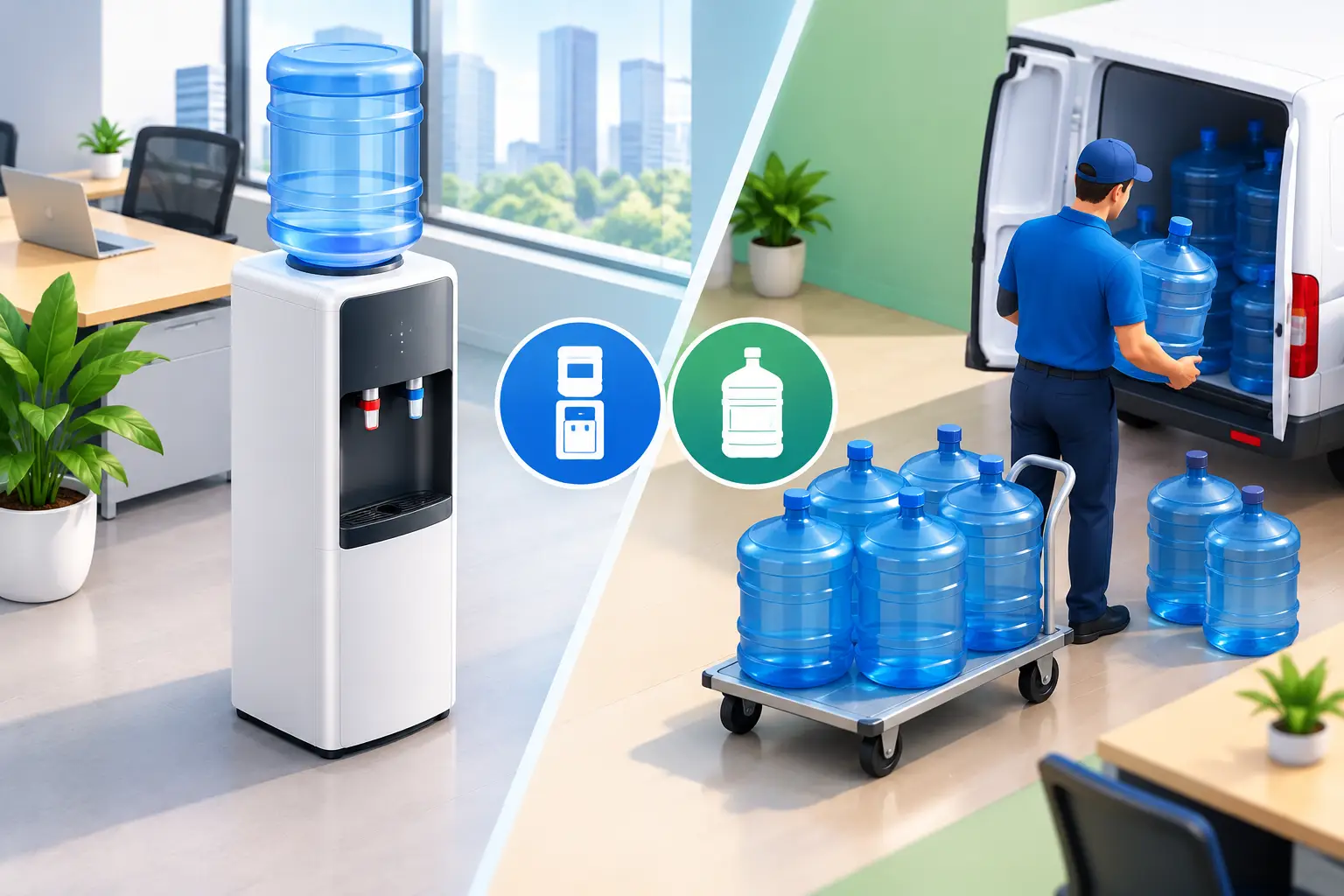
A busy office can go through more drinking water than expected. Between employee refill bottles, client meetings, break room coffee, and hot South Florida afternoons, the right water setup affects convenience, operating costs, and the daily impression your workplace makes. The water dispenser versus bottled delivery decision is not simply about choosing a machine or a jug. It is about choosing the level of service, capacity, and flexibility your team needs.
For some workplaces, scheduled bottled water delivery remains the most practical option. For others, a point-of-use water dispenser offers a steady supply without storing bottles or waiting for deliveries. The best choice depends on your office size, water use, building setup, and the kind of support you expect from your break room provider.
Water Dispenser Versus Bottled Delivery: The Key Difference
A point-of-use water dispenser connects directly to your building’s water line. The unit filters the water and provides chilled, ambient, sparkling, or hot water depending on the model. Because it uses the existing water supply, there are no five-gallon bottles to lift, store, or replace.
Bottled water delivery uses sealed water bottles, most commonly five-gallon containers, delivered on a recurring schedule. The dispenser draws water from the bottle, and the delivery provider exchanges empty bottles for full ones during regular service visits.
Both options can provide employees with better-tasting water than a standard faucet and can reduce reliance on single-use plastic bottles. The practical difference comes down to how water arrives, how much your office uses, and who manages the details when supplies run low or equipment needs attention.
When Bottled Water Delivery Makes Sense
Bottled water delivery is a reliable choice for offices that want a familiar, straightforward setup. It is especially useful in locations where connecting a dispenser to a water line is not practical, such as leased spaces with limited plumbing access, temporary offices, construction trailers, or certain shared commercial environments.
The water source is also easy to understand. Your office receives sealed bottles, employees can see when a replacement is needed, and a scheduled route service keeps your supply moving. For small teams with moderate consumption, this can be an efficient approach without the need for installation work.
Bottled delivery is often a strong fit when flexibility matters. An office that is expanding, relocating, or operating from a short-term space may prefer equipment that can move with the team. It can also work well as a secondary water station in a conference room, warehouse, or area without convenient access to plumbing.
There are trade-offs. Full bottles require floor space, and empty bottles need to be stored until the next delivery. Someone must also monitor inventory and replace bottles as needed. A five-gallon bottle weighs more than 40 pounds, so lifting and changing it can be inconvenient for employees. If a growing office uses water quickly, running out between delivery days can become a recurring frustration.
When a Point-of-Use Water Dispenser Is the Better Fit
A plumbed-in dispenser is designed for workplaces with consistent water demand. Once installed, it provides an ongoing supply without bottle changes, delivery storage, or the concern that the last bottle will run out before the next route visit.
For a mid-sized or large office, that continuity can be a meaningful operational advantage. Employees can fill reusable bottles throughout the day, guests can access chilled water in reception or meeting spaces, and the break room stays more organized. Models with hot-water capability can also support tea, instant meals, and other workplace needs without adding another countertop appliance.
Point-of-use systems can offer an especially polished experience when paired with modern features such as touchless dispensing, enhanced filtration, sparkling water, or ice. These options support employee wellness while giving a shared space a more current, hospitality-minded feel.
The primary consideration is installation. The location needs access to a suitable water line and power source, and the dispenser must be selected for the expected volume of use. A reputable provider should assess the site, recommend the right equipment, and handle installation professionally. Ongoing filter changes, cleaning, and service are equally important. A dispenser is only convenient if it continues to perform consistently.
Comparing Cost Beyond the Monthly Invoice
Budget matters, but the lowest visible monthly charge is not always the lowest long-term cost. Bottled delivery costs generally rise with consumption because each bottle must be filled, transported, delivered, retrieved, and replaced. High-volume offices may also need more frequent deliveries or keep a larger inventory on-site to avoid shortages.
A point-of-use water dispenser often has a more predictable monthly structure because the water comes from the building supply. This can make planning easier for organizations with steady or growing employee counts. Over time, offices with substantial water consumption may find that eliminating recurring bottle volume and storage needs creates better value.
Still, lower water volume does not automatically mean bottled delivery is the right answer, and higher volume does not automatically mean a plumbed-in unit is best. Consider the total working cost: delivery access, storage space, staff time spent changing bottles, installation requirements, service coverage, and how often your team hosts visitors or events.
A practical question for facilities managers is not just, “What will we spend?” It is, “What will our team have to manage?” The right program should reduce small daily tasks rather than create them.
Water Quality, Maintenance, and Employee Confidence
Both options can provide quality drinking water when managed correctly. With bottled delivery, the sealed bottle provides a clear and familiar source. With a point-of-use dispenser, water quality depends on appropriate filtration, timely filter replacement, proper sanitization, and dependable equipment service.
For either system, the provider matters as much as the dispenser itself. Employees notice when water tastes off, when a unit leaks, when the hot-water function stops working, or when the break room runs out of supplies. These are small disruptions, but they add up quickly in a shared workplace.
Ask prospective providers how service requests are handled, how often equipment is maintained, what happens if a unit requires repair, and whether they can support multiple break room needs. A water program works best when it is part of a broader service relationship, not another vendor your office must chase for answers.
Choosing the Right Setup for Your Workplace
Start by looking at daily use patterns. A small office with limited storage concerns and no available water line may be well served by bottled delivery. A large office with employees regularly filling reusable bottles may benefit from the unlimited access and cleaner footprint of a point-of-use dispenser.
Next, consider location. Reception areas and conference rooms may call for a sleek, guest-ready unit. A production floor or warehouse may need durable equipment positioned for easy access. If your organization operates several locations, consistency in equipment, replenishment, and service reporting can simplify administration.
Finally, choose a partner that takes responsibility after installation or delivery. Water is a simple workplace essential until it is unavailable. Certified Coffee Service helps South Florida workplaces coordinate water solutions alongside coffee, tea, vending, and break room supplies, with the hands-on support behind its Service Above All commitment.
The best water choice is the one your employees barely have to think about: fresh, available, professionally maintained, and ready whenever the workday calls for it.