
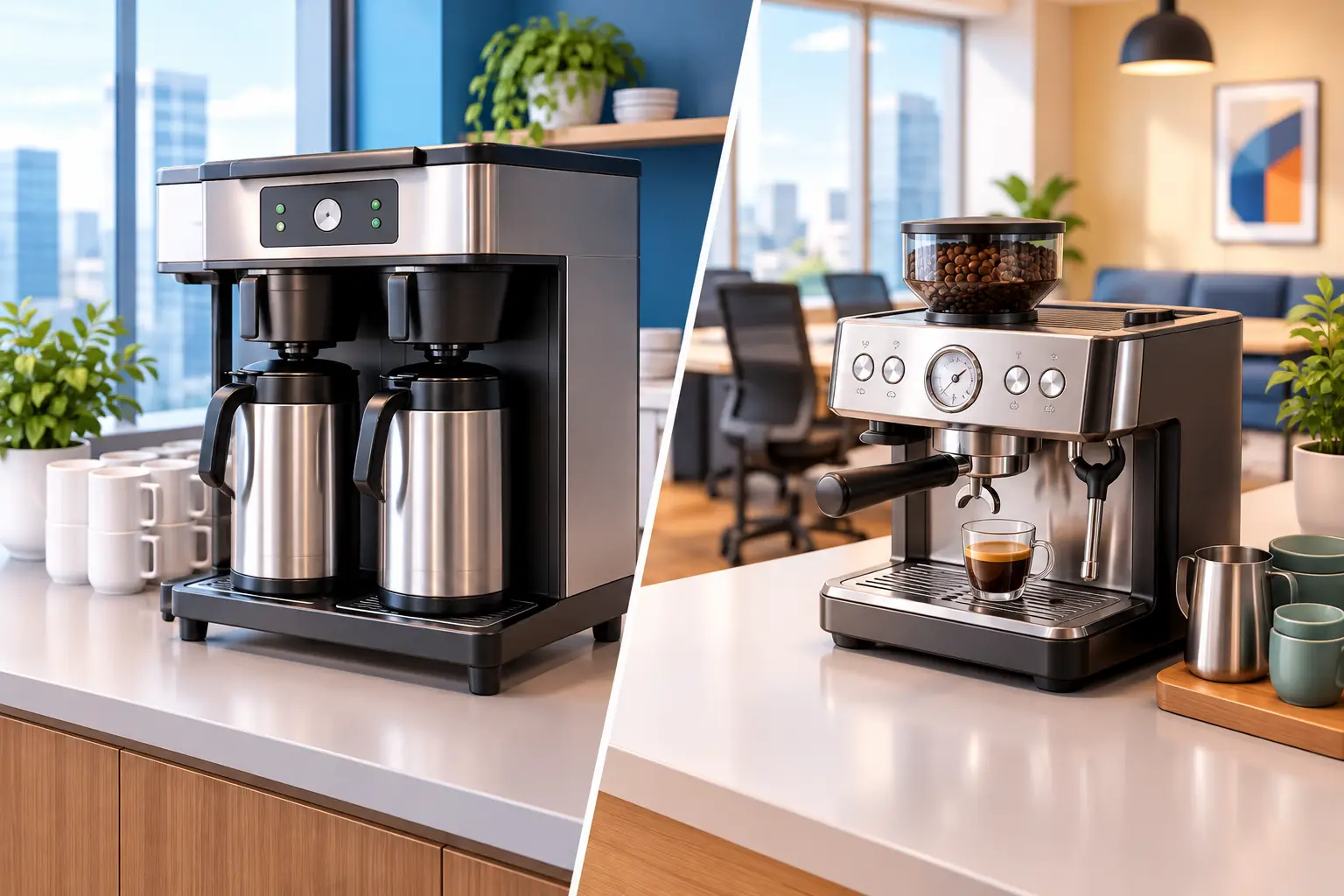
The choice between a commercial brewer vs espresso machine affects more than what is served in the break room. It shapes morning traffic, employee expectations, supply needs, cleaning routines, and the level of support your workplace will require. For some offices, a dependable brewer that keeps coffee ready for a team meeting is the right answer. For others, espresso-based drinks make the break room feel more premium and give employees a better reason to step away and recharge.
The right equipment is not necessarily the machine with the most features. It is the machine that fits your team’s habits, your available space, and your need for dependable day-to-day operation.
Commercial Brewer vs Espresso Machine: The Core Difference
A commercial coffee brewer is built to produce regular drip coffee in larger quantities. It may brew into glass decanters, airpots, or insulated thermal servers, depending on the model and workplace setup. Employees can pour a cup quickly, refill it easily, and get back to work. Traditional brewers are familiar, efficient, and especially well suited to offices where coffee is a daily staple.
An espresso machine uses pressurized water to make concentrated espresso shots. Depending on the equipment, those shots can be served on their own or used for lattes, cappuccinos, Americanos, and other specialty beverages. Many workplace espresso systems are fully automatic, grinding whole beans and preparing drinks with a push of a button. Other machines require more hands-on preparation and employee training.
The distinction matters because these machines solve different problems. A brewer is designed around serving volume and speed. An espresso machine is designed around beverage variety and a more customized coffee experience.
When a Commercial Brewer Is the Better Office Choice
A commercial brewer is often the practical choice for offices with steady demand for regular coffee. Think of a busy administrative office, call center, medical practice, warehouse, or customer-facing business where employees want a familiar cup without waiting for a specialty drink cycle.
Brewers work particularly well when several people need coffee at once. A meeting that starts at 8:30 a.m. does not need six employees standing in line for individual drinks. With a thermal brewer or airpot setup, a fresh pot can be ready before the meeting begins and remain available without relying on a hot plate for extended periods.
This equipment category also keeps the beverage program straightforward. Ground coffee, filters, cups, stirrers, sweeteners, creamers, and cleaning supplies are easy to organize and replenish. There are fewer beverage choices to manage, which can be an advantage for offices that prioritize consistency over customization.
A commercial brewer is not a lesser experience. With quality coffee, proper brewing settings, clean equipment, and timely service, it delivers the classic coffee most employees expect. It can also offer a strong value when the majority of your team drinks regular coffee rather than lattes or espresso drinks.
Best fit for brewers
Commercial brewers generally make sense for workplaces with high consumption of drip coffee, shared coffee breaks, conference rooms, and teams that value speed. They are also a smart fit where counter space is limited or where the person managing office amenities needs a simple, proven setup.
When an Espresso Machine Makes More Sense
An espresso machine can be a meaningful workplace upgrade when employees expect choice, freshness, and café-style beverages. This is especially true in professional offices, creative teams, executive suites, showrooms, hospitality settings, and organizations using their break room as part of their employee experience.
A fully automatic bean-to-cup espresso machine can prepare coffee from freshly ground beans while offering options such as espresso, coffee, cappuccino, latte, and hot water for tea. The appeal is clear: employees can choose a drink that suits them without leaving the building or depending on a single nearby coffee shop.
Espresso systems are also useful for offices where regular drip coffee has created waste. With a pot brewer, coffee is often prepared in anticipation of demand. If traffic is unpredictable, some of that coffee may sit too long or be discarded. A bean-to-cup machine prepares many drinks one at a time, which can help match production more closely to actual consumption.
There are trade-offs. An espresso machine takes longer per drink than pouring from a ready thermal server, especially during a morning rush. Milk-based beverages require attention to milk systems, cleaning requirements, and supply management. The machine may also call for a water connection, filtration, proper electrical access, and enough countertop clearance for service.
Best fit for espresso machines
Espresso machines are a strong option for offices with a quality-focused culture, moderate but varied beverage demand, and employees who appreciate specialty drinks. They are most successful when the organization is prepared to support the equipment with the right coffee, milk or milk alternatives, cleaning routine, and responsive service.
Compare Volume, Variety, and Traffic Patterns
The best decision starts with how people actually use the break room. Do employees arrive in waves, or do they stop by throughout the day? Are they mostly drinking regular coffee, or are they asking for cappuccinos and lattes? A machine should support real behavior rather than an idealized version of it.
A brewer has the advantage during high-volume moments. It can serve a large group quickly, and multiple brewers or servers can be used for larger offices, training rooms, and events. This makes it a dependable choice for workplaces with predictable rush periods.
An espresso machine offers more variety, but it has a practical throughput limit. A good automatic system can handle a busy office, yet individual beverage preparation still takes time. In a 100-person office where nearly everyone arrives within the same 20-minute window, an espresso machine may work best alongside a brewer, not as a complete replacement.
For many organizations, a combined approach is the most sensible answer. A commercial brewer keeps regular coffee flowing, while an automatic espresso machine gives employees access to premium drinks. The result is choice without creating a morning bottleneck.
Consider Service Before Selecting Equipment
Coffee equipment is only an asset when it is clean, stocked, and working properly. That is why service should carry as much weight as the equipment specification. A brewer with an empty coffee supply or a machine that has not been cleaned properly does not support employee satisfaction. The same is true of an espresso system that is down because of neglected maintenance.
Commercial brewers typically have simpler daily care requirements, but they still need regular cleaning, descaling as needed, and attention to water quality. Espresso machines have more components and more detailed sanitation needs, particularly when they include a milk system. Employees should understand which daily tasks they are expected to complete and which maintenance tasks are handled by the service provider.
A full-service office coffee partner can simplify this process by matching the right machine to the location, providing coffee and related supplies, monitoring account needs, and responding when equipment needs attention. For South Florida workplaces, Certified Coffee Service brings this service-first approach to equipment, beverage replenishment, and break room support. The goal is not simply to place a machine. It is to keep the coffee program dependable after installation.
Budget for the Full Coffee Program
Equipment cost is only one piece of the decision. Consider the ongoing cost of coffee or whole beans, filters, cups, lids, sweeteners, creamers, cleaning products, water filtration, and service. An espresso machine may have a higher equipment and ingredient cost per drink, while a traditional brewer can offer economical servings of quality drip coffee at scale.
That does not automatically make the brewer the better value. If employees regularly leave the office to buy specialty beverages, an espresso program may support retention, convenience, and workplace morale in ways that are harder to measure on a supply invoice. The key is to choose a program that feels appropriate for the organization rather than overbuilding for a small team or under-serving a large one.
Ask prospective providers how they handle equipment maintenance, emergency service, consumable replenishment, and product changes. A clear support plan prevents small break room issues from becoming someone else’s recurring administrative task.
Make the Choice Based on How Your Team Works
Choose a commercial brewer when speed, high-volume drip coffee, straightforward operation, and familiar service are the priority. Choose an espresso machine when specialty beverages, fresh-ground coffee, and a premium employee experience are more important. Consider both when your office needs to serve a broad range of preferences without compromise.
The best coffee setup should feel easy to employees and manageable to the people responsible for the workplace. When the equipment, products, and service plan match the rhythm of your office, a good cup of coffee becomes one less detail to manage – and one more reason people enjoy coming to work.